

Before using a tie-down strap, you should inspect along the length of the webbing for signs of wear and tear. If your strap is worn or damaged, do not use it and replace it immediately.
An important part of ratchet strap maintenance is keeping your ratchet mechanism moving freely, so it's important to inspect the ratchet and oil it regularly to ensure that the strap won't rub unecessarily when moving through the tension device as it's tightened or loosened.
This Tie-Down Defect Table outlines how to measure defects in strap webbing so that compromised straps can be removed from service in accordance with the North American Standard Out-of-Service Criteria.
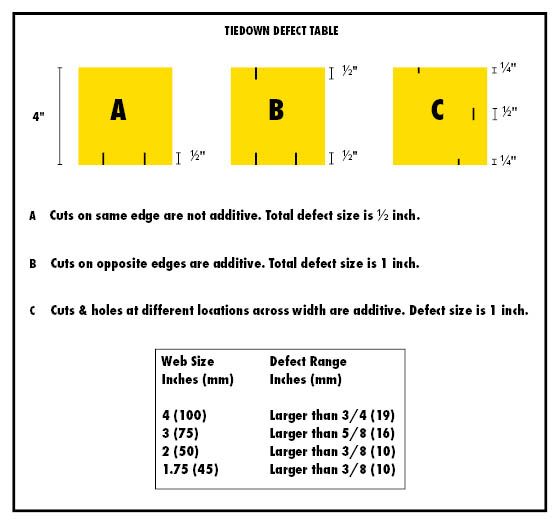
The following photos illustrate potential things to look for when inspecting your ratchet or winch strap webbing.
Abrasion
Occurs when the strap rubs against another object for an extended period of time.

Broken Thread
The sewn part of the webbing is compromised when the thread breaks, as this is an intergral part of ensuring the strap's strength under pressure.

Burns
Occurs when the polyester strap comes into contact with a hot object for an extended period of time, or when sunlight is concentrated on a single spot for an extended period of time.

Caustic Burn
Occurs when chemicals or acidic fluid come into contact with the polyester, effectively melting it.
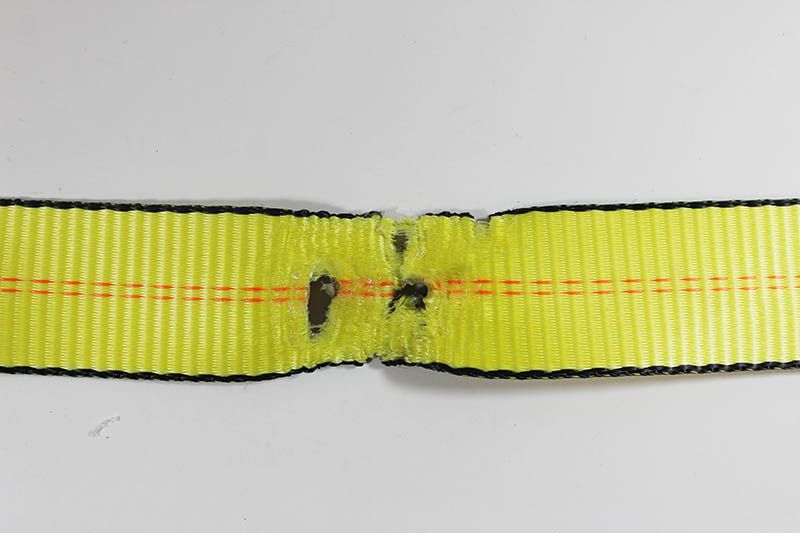
Crushed
Occurs when an object of extreme weight or under heavy load compresses the webbing severly, resulting in distortion of the webbing.

Cut
A sever in the webbing due to actue or extended abrasion against a sharp object.

Embedded Object
A foreign item such as a shard of glass, piece of metal or other object gets caught in between the fibers of the webbing.

Knot
The webbing becomes twisted upon itself due to intentional knotting, improper storage, or improper collection of loose webbing in transit. While knotted, the strength of the strap is compromised.

Snag
The polyester fibers have caught on a foreign object, broke, and come loose from the structure of the webbing.

Ultraviolet (UV) Damage
The top strap has no UV damage; the lower strap has faded from strong yellow to a pale yellow due to UV exposure. It's worth noting that UV exposure doesn't require sunlight and can occur on cloudy days as well, which is why it's critical to store straps properly, out of the elements.


